The Town Musicians
1. The Donkey
A donkey named Greycoat had grown so old and feeble that he was of no more use to his master.
One night he heard his master and mistress talking together. “Why do you still keep that donkey,” said the woman; “he is of no use to you. And you only waste your money buying food for him.”
“That is true,” answered the man. “I would do well to get rid of him. I might sell his hide to the tanner. He is no good for work but he will be good for leather.”
When the donkey heard this he knew it was time for him to leave, if he wished to keep his skin for his own use.
He pushed the stable-door open with his nose, and escaped down the road without saying goodbye to anyone.
“I may be too weak to work,” said the donkey, “but my voice is still strong. I will go to the big city and become a singer.”
2. Bellmouth The Dog Joins The Band
He had not gone far when he saw an old hound dog lying beside the road and whining. “Well, old Bellmouth,” said the donkey, “what ails you? You seem to be in trouble.”
“Trouble indeed,” answered the hound. “I have grown so old and stiff that I am no longer able to run with the other dogs in the pack. So my master has no more use for me. He drove me away and threw stones at me. I have no home anymore. What is to become of me now I do not know. If my master would not keep me I am sure no one else will.”
“Do not trouble yourself over that,” said the donkey. “I am going to the city to be a musician, and if you like you shall come along and sing with me. I know you have a fine voice, and we together may make our fortunes.”
The hound was pleased with this idea. He got to his feet, and he and the donkey went on together in company.
3. Whiskers The Cat Joins The Band
A little while after they came to where a cat sat in the grass by the roadside. This cat looked as sad and doleful as a rainy day in fall.
“What is the matter with you, Whiskers?” asked the donkey. “You look as though all the cream were sour and all the rats were dead.”
“There is no cream for me nowadays,” said the cat, “and though there are plenty of rats I am too old to catch them. I am no longer quick and active, and I would rather sit by the fire and purr. For this reason my mistress has driven me out of the house with a broom, and I have no place to go. What would you advise me to do?”
“Come with us,” said the donkey. “Brother Bellmouth and I are going to the city to be musicians, and if you choose to come along and join your voice with ours we shall be glad to have you.”
The cat was delighted, and leaping out into the road it trotted along beside the others.
4. Master Red-Head The Rooster Joins The Band
Soon they came to a farmyard, and a rooster had flown up on the gate post. It stretched its neck and crowed, and crowed again.
“Enough! Enough!” cried the donkey. “Do you want to split our ears with your crowing?”
“I must crow while I can,” said the rooster, “for that is my business. Every morning I crow to wake the men, and I also crow to tell what weather we will have. But I heard the mistress say that guests will becoming tomorrow and that she must make me into soup, so my crowing days are almost over.”
“That is a bad business,” said the donkey. “You had better come with us. We are going to the city to become musicians, and such a voice as yours would be a great help.”
The rooster did not wait to be asked twice. He flew down from the gatepost and joined the donkey, the hound, and the cat.
The rooster flapped along beside them, but this was tiresome. So the donkey invited the rooster fly up on to his back, and after that Master Red-head the rooster rode along in comfort.
Soon it began to grow dark, and still the musicians had not come within sight of the big city. Instead they came to a deep forest, and after wandering around in it for some time they grew so weary that they decided to go no farther that night.
5. The Band Sleeps Under A Tree
The donkey and the hound lay down under a large tree, the cat climbed up to a fork of the branches, while the rooster was not content to roost anywhere but at the top of the tree.
The rooster had not been sitting at the top of the tree long when he said, “Brothers, I see a light not far off. There must be a house there.”
“That is good news,” said the donkey. “I for one have no liking for sleeping on the bare ground. Perhaps if we go there and sing they may give us a place to sleep for the night.”
This plan seemed good to the others. The cat and the rooster came down from the tree, and the four musicians set out together in the direction of the light.
6. The House Of Robbers
It was not long before they came to a house. And the light the rooster had seen shone through a lower window. The donkey, being the largest, was chosen to look in through the window and tell the others what he saw.
The donkey looked so long and so silently that the others grew impatient. “Well, Brother Greycoat, what do you see?” asked the hound.
“Brothers,” said the donkey in a low voice, “I can easily see that this house belongs to a band of robbers. They have a quantity of treasure piled up in one corner of the room, and they are sitting around the table eating and drinking.”
“Oh, if we could only scare them away and take the treasure for ourselves! Robbers are always cowards,” said the dog.
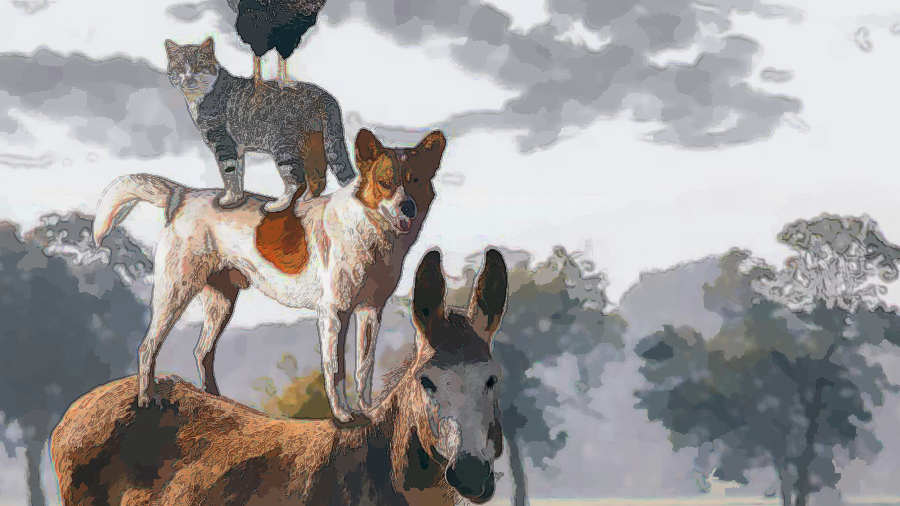
The four companions consulted together and made a plan to frighten away the robbers. The donkey put his front feet up on the windowsill, the dog mounted on the donkey’s back, the cat mounted on the dog’s back, and the rooster flew up on to the cat.
So they all stood on top of each other.
When the donkey gave the signal, they all began to sing together. The donkey brayed, the dog howled, the cat meowed, and the rooster crowed.
The noise they made together was awful. The robbers jumped up in a fright, and as soon as the animals saw they were frightened they smashed the glass window and sprang into the room.
The frightened robbers fled out of the door and into the woods without stopping to look behind them.
“That was easily done,” said the donkey. The animals then sat down at the table and ate and drank to their hearts’ content.
After that they put out the lights, and then they settled down for the night, each one in the most comfortable place it could find. The donkey lay down on a heap of straw outside, the dog curled up behind the door, the cat settled down on the warm ashes, and the rooster flew up and perched on the rafters. Then they all went to sleep.
7. The Robbers Investigate
Out in the forest the robbers wandered around for awhile, and then they all got together and talked things over.
“We were very foolish to be so easily frightened,” said the captain. “I have been listening and watching, and everything is quiet around the house and the lights are out. Let us go back there and see if anyone is there.”
To this the other robbers agreed. They crept back to the house, and the captain sent one of the men inside to see what was doing.
The man carefully went to the house in and looked around. And he saw the cat’s eyes shining in the dark. He thought they were live coals in the ashes. And as he needed more light, he went up and stuck a stick toward the cat, meaning to stir the coals and make a fire.
At once the cat sprang up with a yowl and scratched his face. The man was terrified. He ran to the door and the dog sprang out and bit him. He tumbled out into the courtyard and the donkey kicked him. The noise woke the rooster and it stretched its neck and crowed “rooster-a-doodle-doo!”
The robber ran back to his captain trembling. “Let us get away!” he cried. “A horrible witch sits by the hearth, and she flew at me screaming, and bit and scratched me. A man behind the door stuck a knife in my leg. Outside a hideous black thing hit me with a club, and on the roof sits a judge who cried, ‘Bring the rascal here!’”
The robbers waited to hear no more. They took to their heels and ran away.
But the four comrades found it so comfortable in the robbers’ house, that they never went to the big city to become musicians after all. They stayed there at the house enjoying the robbers’ treasure and each other’s company.